
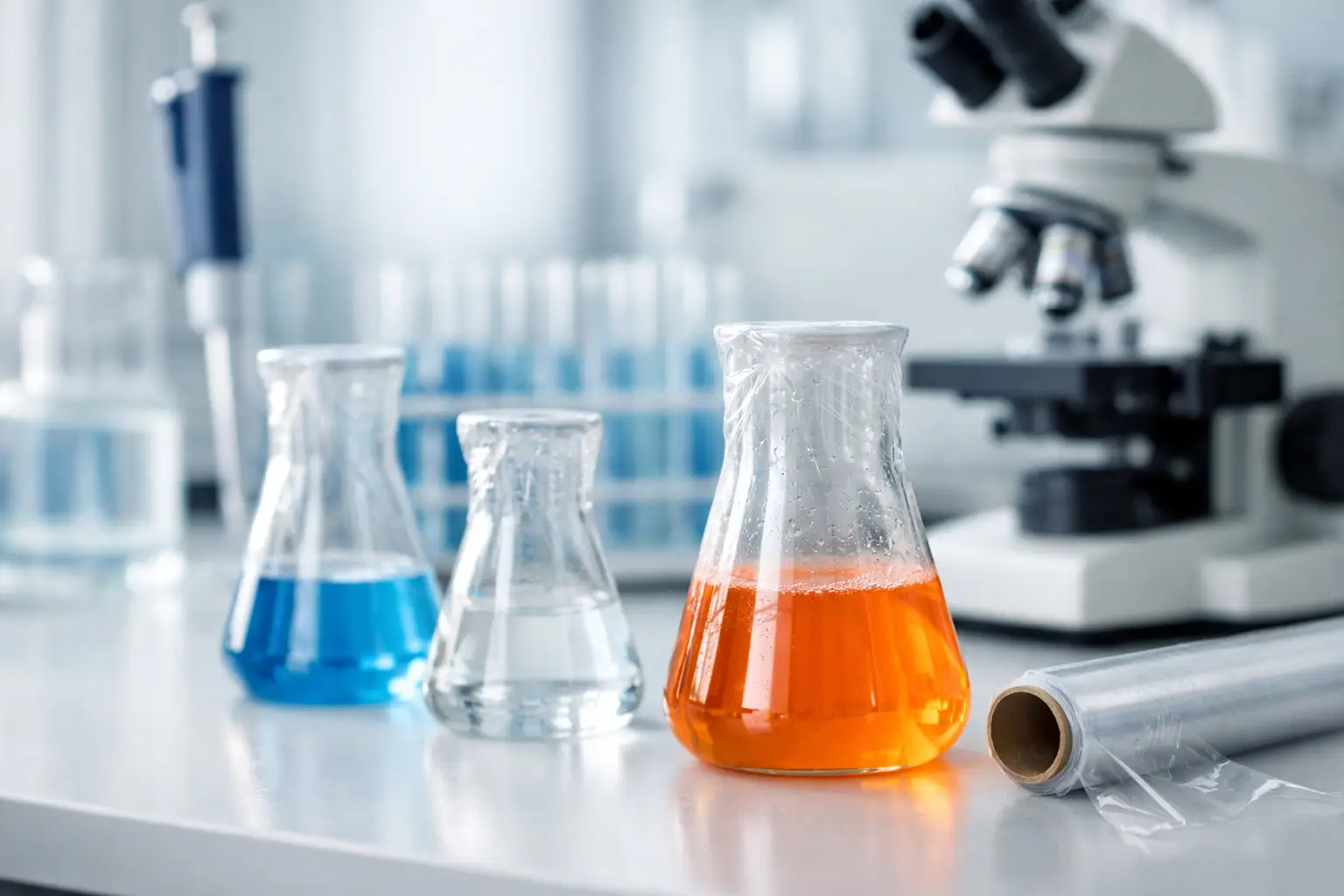
A flask seal usually fails at the worst possible moment – after incubation, during transport, or halfway through a run when a small loss turns into compromised data. That is why sealing film for laboratory flasks is not a minor consumable decision. It affects sample integrity, workflow consistency, and purchasing efficiency in ways every lab and distributor sees quickly.
In real lab use, the challenge is rarely just closing a vessel. It is closing it well across different neck sizes, glass profiles, temperatures, and handling conditions. A rigid cap may be enough for storage, but it is often not the best answer for temporary sealing, secondary protection, or irregular shapes. That is where a flexible laboratory film earns its place.
What sealing film for laboratory flasks needs to do
A good sealing film has a simple job description with demanding real-world requirements. It should stretch smoothly, conform to the flask opening, create a reliable seal, and stay in place without becoming difficult to remove. If it cannot handle irregular surfaces, light pressure changes, or common lab handling, it creates more work than it saves.
For research labs, chemistry environments, pharmaceutical operations, and microbiology workflows, the priorities are usually the same. Teams want to reduce evaporation, prevent leakage, and limit contamination risk. They also need a material that does not slow down bench work or make visual checks harder than they need to be.
Clarity matters more than buyers sometimes expect. When staff can inspect liquid level, turbidity, or vessel labeling without fighting an opaque wrap, routine work moves faster. Stretchability matters too. A film that conforms cleanly to flasks, beakers, and other uneven vessel shapes reduces the temptation to overwrap, double seal, or improvise with tape.
Why flasks are harder to seal than they look
Laboratory flasks are not standardized in the way many procurement catalogs suggest. Even within one lab, users may move between Erlenmeyer flasks, volumetric flasks, culture flasks, and side-arm variations with different lips, neck diameters, and handling demands. Some applications need a short-term barrier during sample prep. Others need a dependable seal through storage, transport between stations, or incubation.
This is where generic films often fall short. They may cling at first but lose hold under stress, wrinkle around the neck, or tear when stretched over a wider rim. The immediate issue is inconvenience. The larger issue is process inconsistency. If users cannot trust the seal, they compensate with extra material, extra checks, and extra time.
For procurement teams and distributors, that inconsistency becomes a cost issue. A lower unit price means little if the product is wasted, frequently replaced, or triggers user complaints. Reliable sealing film should improve both technical performance and purchasing confidence.
Performance factors that separate a dependable film from a weak one
The first differentiator is conformability. A film designed for laboratory use should wrap tightly around a flask neck and adapt to small variations in shape without splitting or lifting. This is especially important where users work quickly and cannot afford repeated resealing.
The second is moisture resistance. In many applications, the film acts as a practical barrier against evaporation and environmental exposure. That barrier does not need to replace every closure system, but it should reduce loss and protect samples in routine use.
The third is self-sealing behavior. Labs do not want a film that requires excessive force, complicated application, or secondary fastening just to perform its basic role. A material that bonds to itself cleanly and forms a stable wrap is easier to use across teams with different experience levels.
The fourth is supply reliability. This point is often overlooked until a preferred product becomes unavailable. For distributors and procurement managers, a sealing film is only dependable if it is consistently in stock, arrives on time, and performs the same way from roll to roll.
Where sealing film delivers the most value
In microbiology and cell culture environments, even minor exposure can create avoidable risk. A dependable film helps protect flasks during staging, temporary storage, and transport around the lab. In chemistry settings, reducing drips and evaporation supports cleaner handling and more consistent results. In pharmaceutical and regulated environments, traceability and supply consistency matter alongside performance because purchasing decisions are audited more closely.
That broad usability is why sealing film remains a core consumable rather than a niche accessory. It solves a recurring problem across multiple vessel types and departments. When the product performs well, users stop thinking about it. That is exactly the point.
Choosing sealing film for laboratory flasks without overbuying or under-specifying
The best purchasing decision starts with use case, not habit. If your team mainly needs temporary sealing during sample handling, flexibility and fast application may matter most. If your workflow involves longer holds, movement between work areas, or exposure to temperature variation, seal retention and moisture resistance become more important.
It also helps to ask how many vessel types the film needs to cover. A product that works only on a narrow range of flask openings can create hidden complexity in inventory management. A film with enough stretch and clarity to serve across beakers, flasks, and irregular labware usually delivers better value because it reduces SKU sprawl and simplifies user training.
For distributors, the evaluation is broader. End users want performance, but your margin depends on dependable replenishment, low complaint rates, and a product story that is easy to sell. A credible alternative to incumbent brands has to prove more than price. It has to show equivalent day-to-day usability, consistent stock availability, and confidence in the supply chain.
Why labs are rethinking the ParaFilm default
Many buyers are familiar with ParaFilm-style sealing products and have used them for years. That familiarity is useful, but it can also keep teams from reassessing value. In practice, labs are asking sharper questions now. Can we get the same function without paying a premium? Can we count on inventory? Can our distributor source the product without delays or channel friction?
Those questions are changing buying behavior. A dependable alternative is no longer judged only by whether it resembles the incumbent. It is judged by whether it solves the same operational problems while improving cost control and availability.
That is why products such as Seal-R-Film have gained traction. Buyers want a flexible, self-sealing laboratory film that handles beakers and flasks effectively, provides clear visibility, resists moisture, and supports regular supply without the pricing pressure tied to legacy brand dependence. For distributors, that combination also creates a stronger resale proposition.
What distributors and procurement teams should ask suppliers
Supplier evaluation should go beyond the datasheet. Ask how inventory is managed, whether the product is traceable by batch or roll, and how fulfillment performs during demand spikes. These are practical questions, not administrative ones. If a sealing film becomes part of regular lab workflow, interruptions create immediate downstream problems.
It also makes sense to assess onboarding support. Distributors benefit from suppliers that can provide samples, product education, and straightforward commercial terms. End users benefit when the supply partner understands technical application rather than treating the film as a generic commodity.
The strongest supplier relationships are built on repeatability. Labs need consistent product performance. Distributors need consistent product movement. Procurement teams need fewer surprises.
The case for treating sealing film as a performance purchase
It is easy to think of laboratory film as a low-level consumable, but the consequences of poor performance show up quickly – leaking vessels, lost volume, contamination risk, and frustrated staff. That makes sealing film for laboratory flasks a performance purchase, not just a line item.
The right film supports cleaner handling, more reliable sample protection, and smoother bench work across vessel types. The right supply partner supports margin, continuity, and purchasing confidence. When both are in place, labs spend less time compensating for packaging weaknesses and more time moving work forward.
If your current film creates doubt at the bench or friction in the supply chain, that is the signal to reassess. A dependable seal should be routine, not something your team has to work around.